
Introduction
By Adrian Ma
We tend to use the word “coincidence” to describe, and perhaps dismiss, certain remarkable occurrences as matters of pure chance. But sometimes, coincidences feel different: they feel meaningful, even if only in some vague, uncanny way. Imagine receiving news of a death of which you had dreamt the previous night, or soulmates whose paths converged through a seeming conspiracy of time and place. But what, exactly, explains the perceived significance of such moments—which often disturb or enchant even skeptics of spirituality or supernatural design? At our latest Curiosity Café, moderated by Jla Starr Johnson and Sofia Panasiuk, we explored the meaning we find in coincidences (or create out of them), and what these experiences can reveal about the human psyche and condition. But first:
Featured Content:
Curiosity Café Recap: Coincidence
Community Survey
Lingering Questions from Art: What’s the Point?
Upcoming Events
Our Final Café of 2025: Regret (December 16)
Our Annual Public Philosophy Social in January! (January 31st, 2026)
Curiosity Café Recap: Coincidence
By Adrian Ma
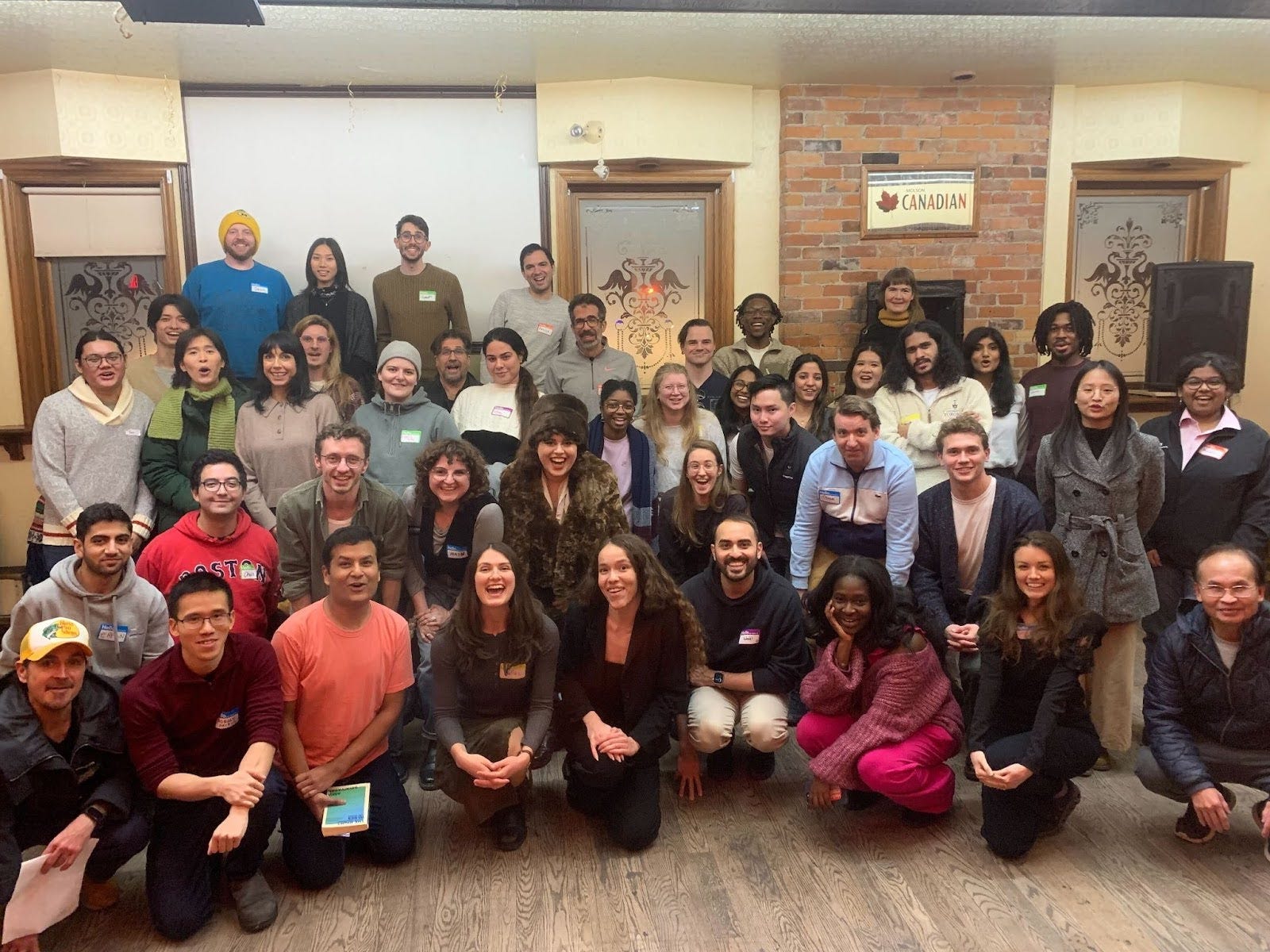
Our latest Curiosity Café, moderated by Jla Starr Johnson and Sofia Panasiuk, began with our examining what, if anything, our experiences of coincidences can tell us. We asked:
Have you ever experienced a remarkable series of events without an immediate explanation or answer? What happened?
What was your first reaction?
To what did you attribute the cause of these events at the time? Do you have a different explanation now?
Some say that coincidences have meaning. Do you agree?
Hint: Meaning could be drawn from several features of a coincidence including subjective significance of the events, connections and patterns, purpose or even emotions. Do you think these features are meaningful?
Does your relationship to coincidence reflect something about who you are?
Is your relationship to coincidence reflective of how you see the world? Your beliefs? Your personality traits?
How, if at all, are coincidences connected to your sense of identity?
Do you believe that coincidences help us make sense of the world around us?
Do coincidences happen to us independently of our predisposition to connect the dots?
Does meaning come from the event/coincidence itself or your interpretation of it?
Is finding meaning in coincidence similar to how we find meaning in art, our dreams and emotions? How is it different?
Here’s what some of you had to say:
Coincidences seem meaningful because we give them meaning. Imagine flipping a coin which lands on heads 10 consecutive times. That would feel very strange indeed—but only because we attribute meaning to the outcome of an unbroken series of heads. In reality, the sequence was statistically just as probable (or improbable) as any other combination of heads and tails.
Humans are meaning-making creatures, with a tendency to assign importance to things and events that are not inherently special or reflective of cosmic design. Seeing a cat on a stroll, we might ask: why, of all the cats I could have seen on this particular day, did I run into this one, with fur of such a colour, and ears of such a shape?
Many weird coincidences are the result of our subconsciously picking up on clues and drawing connections without being aware of it. For example, if I happen to dream about a breakup before it occurs, that dream was likely informed by prior intuitions of hidden tensions within the relationship.
Anything can appear strikingly coincidental, if we are sufficiently creative in drawing connections between objects and events. Even a seemingly random string of numbers can be interpreted as having some mysterious cosmic importance for my life. I might reason: the first two numbers are the last two digits of my birth year, the subsequent four are the sum of my mother’s age and the age of my closest friend … surely the universe must be telling me something!
We often try to explain (but potentially explain away) coincidences by appealing to hidden workings of cause and effect, like when we say, “God intended for this to happen.” However, such explanations fail to do justice to what makes coincidences feel so meaningful, and might even disqualify such occurrences as coincidences altogether. Coincidences make an impression because they appear to be matters of chance, rather than matters of design or causal necessity. They did not need to and were not intended to happen, and yet, somehow, they did! Perhaps what is magical about coincidences is that there is no causal explanation to be found. Magic can still be magic without having causal force.
Coincidences happen because we filter the world through our own lenses, in terms of our own interests, values, beliefs, and so on, and are therefore more likely to notice things we are already concerned about. Have “coincidences” become more frequent in contemporary life, given that so many of us now live in curated digital worlds, where algorithmically driven feeds give preference to content about things we are already interested and engaged in?
Our knowledge is and will always be incomplete, and we can never fully rule out the possibility of magic. Think of what artists do: isn’t there something magical about the artistic process, which creates and brings to life characters, places, and stories seemingly out of nowhere?
If there is an “other side,” an afterlife or hidden supernatural dimension of reality signs of which we can glimpse in this world, those signs (which might include uncanny, inexplicable coincidences) must be ambiguous. Their significance is always intensely personal, and can neither be shared with nor understood by others.
After the break, our attention shifted to the social significance of coincidence, and what the meaning we find or seek in coincidence reveals about the human mind and heart. We asked:
Have you ever received a reading from a mystic, psychic or other spiritual practitioner?
If yes: What was that like?
If no: Have you ever been curious to receive a reading? Why or why not?
What does the proliferation of these practices suggest?
For instance, do they tell us about a desire for control over uncertainty? A way to resist nihilism (the philosophical theory that life has no inherent meaning)? Something else?
Do these practices offer us a glimpse into how coincidence works? Do they help us to better understand the role coincidence plays in our lives?
How does deriving meaning from coincidences shape relationships between people? (Think of phrases like “we met at the perfect time” or “it was meant to be”...)
Here are a few of your responses:
Tasseography helps us make sense of our own lives by representing different aspects of them in symbolic form. In so doing, it adds a bit of character and whimsy to bald reality.
Practices like fortune-telling bring a sense of comfort and order in a universe that so often feels chaotic, indifferent, or hostile. They provide understanding in a world of perpetual uncertainty. It’s hard to be human, to inhabit a world where our desire for meaning is so often frustrated, and our need to feel at home is so often met with the cold blank stare of the void. Everybody needs a crutch, and even if we are personally skeptical of such practices, we shouldn’t go around knocking other people’s crutches down.
I am most skeptical of divination when I feel I need it or the knowledge it claims to provide. Such practices are not a reliable guide to action, and I am most likely to defer to their recommendations when I am most desperate for their consolation or direction. That said, I am happy to approach them in a spirit of open-mindedness and curiosity when they make an organic appearance in my life, rather than when I am seeking them as a solution to a personal crisis.
Divination methods are something of a Rorschach test, a test where subjects describe what they see in a series of inkblots with ambiguous forms that lend themselves to a variety of interpretations. Practices like Tarot card readings can be instructive in that they reveal something about our own psychology, even if they do not reveal anything about “objective” reality.
How I react to such practices can also provide valuable insight into my own mental and emotional states. It’s like flipping a coin and realizing I had been secretly hoping it would land on a certain side. My feeling disappointed or satisfied with the conclusion of a Tarot card reading (for example) can be similarly illuminating.
Is there anything we get from divination that we can’t just get from consulting a psychologist? Even if divination can provide psychological insight and therapeutic benefit, it would be better to seek both things from a licensed professional whose practice is scientifically grounded.
We live in a world that celebrates science as the gold standard of knowledge, while pathologizing knowledge of other forms. But while scientific knowledge is indeed valuable, we should preserve a degree of intellectual humility, and remain open to the possibility of there being legitimate alternative systems of knowledge and knowledge-seeking methods. Science isn’t always right: there are many ways of being in the world and identifying that have been, and some which are, wrongly pathologized by psychologists.
We tend to think of meaningful coincidences as largely individual, private experiences, but it is also worth reflecting on the phenomenon of collective or communal coincidences. One example of this is the Mandela Effect, which is when large numbers of people collectively misremember facts or events (such as by having recollections of news footage of the Tiananmen Square massacre that never aired).
Human life is driven by two main goals: dealing with the unknown, and knowing ourselves. Knowledge of whatever form is helpful insofar as it conduces to either goal. But we can also engage in such knowledge-seeking in bad faith. Sometimes, we are just looking to be enabled, to have our biases and inclinations confirmed.
Thanks for reading. As you can see, a link to our Community Survey is just below. That’s not a coincidence: please take it. Your feedback, whether positive or negative, will help us make our offerings better (and maybe come up with new ones).
Community Survey
For those who’ve attended our Curiosity Cafés, please consider taking our brief community survey. We are conducting this survey to gather feedback on our events, and it should only take a few minutes to complete. Your responses are completely anonymous and will be invaluable in helping us improve our offerings. Thank you in advance!
Lingering Questions from Art: What’s the Point?
While we don’t provide recaps for our Revisited series, moderator Sophia put together a list of lingering questions that she and others in attendance left with. Here are a few from our last Revisited café:
What is the relationship between art and hope?
How might the psychological function of creativity be related to the point of art?
Does art do better when it imitates reality, or when it perfects reality?
What do we mean by “communication”? Must communication necessarily involve both the communicator intending to, and subsequently conveying, a particular message, and the receiver receiving it as it was intended?
Does intent matter in order for something to be considered art?
Can AI make art?
What does it mean for art to have a “purpose”? Must its purpose be endorsed by the artist in order for it to be legitimate?
What counts as reality?
What does “self-expression” actually mean? Is the act of trying to make one’s own individuality disappear as much as possible, in other words, to become a medium through which something else is expressed, necessarily not an act of self-expression? Is an actor acting a form of “self-expression”?
What does “moral instruction” actually mean?
Upcoming Events
Curiosity Café: Bi-weekly on Tuesdays, tickets below!
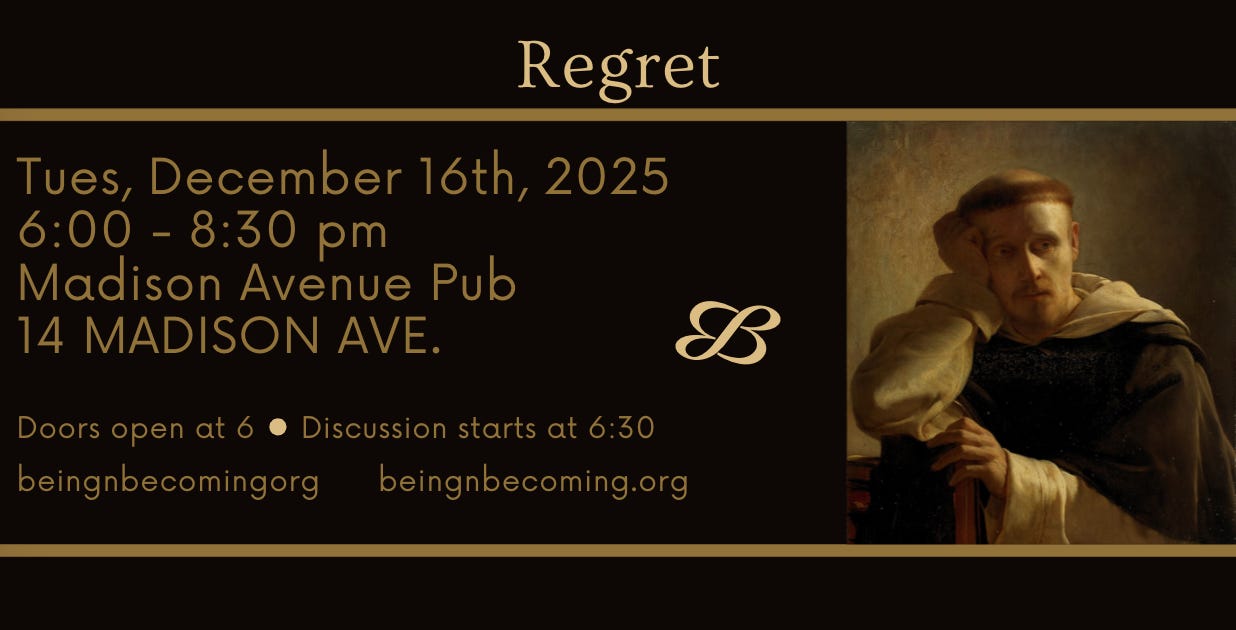
We will host our next Curiosity Café on Tuesday, December 16, from 6:00 to 8:30 p.m. at the Madison Avenue Pub (14 Madison Ave, Toronto, ON M5R 2S1). Come and hang out with us, grab food, and read through our handout from 6:00 to 6:30 p.m. Our structured discussion will run from 6:30 to 8:30 p.m. with a 10-minute break in the middle!
As the year ends, you’re probably regretting some of the decisions you made in 2025. Come talk about it at our final Café of the year.
The topic of our next café is: Regret
Missing the event description? Head over to our Eventbrite page! We’re trying to make the length of our newsletters a little less overwhelming.
If you have accessibility-related concerns, please visit our Eventbrite page—in the event description, you will find some accessibility-related information about the venue and the event.
We still have five free tickets available for our attendees. If paying anything at all is not financially feasible for you or our ticketing system presents some other barrier, please contact our Director of Community Programming, Sophia, at sophia@beingnbecoming.org. These tickets will be given away on a first-come, first-served basis, no questions asked! You can expect to hear back from her within 72 hours.
Save the Date for our Annual Public Philosophy Social
Being and Becoming is hosting its annual public philosophy social on Saturday, January 31st, 2026, from 7–10 pm at the Centre for Social Innovation (192 Spadina Ave).
About the event: For the past two years, we’ve been organizing in-person conversations about love, morality, humour, AI, forgiveness, democracy, consciousness, and more. Once a year, we come together for a big social event that welcomes anyone who enjoys exploring ideas, questions, and experiences with others in a more spontaneous (and perhaps also serendipitous) way than our usual programming.
We’re coming together at one of our favourite venues, the Centre for Social Innovation, to meet friends, spark conversations about questions big and small, and celebrate two years of being and becoming curious together (sorry, we couldn’t resist). There will be just enough facilitation to help you find others who share your curiosity about the same questions, along with refreshments (small bites and non-alcoholic beverages), and a cash bar.
More details and tickets coming soon!
Featured Quote
I am who I am.
A coincidence no less unthinkable
than any other.
- Wisława Szymborska
Our mission is to present a diversity of perspectives and views. The views and opinions expressed in this newsletter are solely those of the individual authors and do not necessarily reflect the views or opinions of Being and Becoming. Being and Becoming disclaims any responsibility for the content and opinions presented in the newsletter, as they are the exclusive responsibility of the respective authors. If you disagree with any of those presented herein, and you feel so inclined, we recommend reaching out to the original author and asking them how they came to hold that opinion. It’s a great conversation starter.