
Intellectual Autonomy
Plus tickets to our final skills workshop of the summer (Thought Experiments and Counterexamples), our upcoming café on anger, a special contribution from Kenneth Boyd, and more!
Introduction
By Alexandra Gustafson
These days, the true value of intellectual autonomy, or thinking for oneself, is perhaps more uncertain than ever: if Artificial Intelligences can “think” much more quickly than humans can, perhaps with much greater accuracy, isn’t it better—more efficient, more exact—to let AI do our thinking for us? If AI “knows” better (and faster), isn’t it just human hubris (pride, of the kind the Ancient Greek gods punished Sisyphus and Prometheus for) to insist on…thinking…slowly?
At the same time, we also live in an era in which facts can now be alternative, news can be fake, and information can be misinforming. For these reasons, these days, it’s perhaps also more crucial than ever that we think carefully, clearly, and with complete autonomy from problematic outside influence.
But is intellectual autonomy always the virtue it is often made out to be—and why? Are there cases where it is better to rely on others than to undertake the search for knowledge alone? Last café, we listened to your thoughts on these pressing questions—remind yourself of them below as a meta-exercise in the value of intellectual autonomy!
But first:
Featured Content:
Curiosity Café Recap: Intellectual Autonomy
Community Survey
“What’s so great about intellectual autonomy?” by Kenneth Boyd
Upcoming Events
Our Last Workshop for Summer 2025: Thought Experiments and Counterexamples (July 19)
Our Next Café: Anger (July 21)
Readings & Resources
Curiosity Café Recap: Intellectual Autonomy
By Adrian Ma
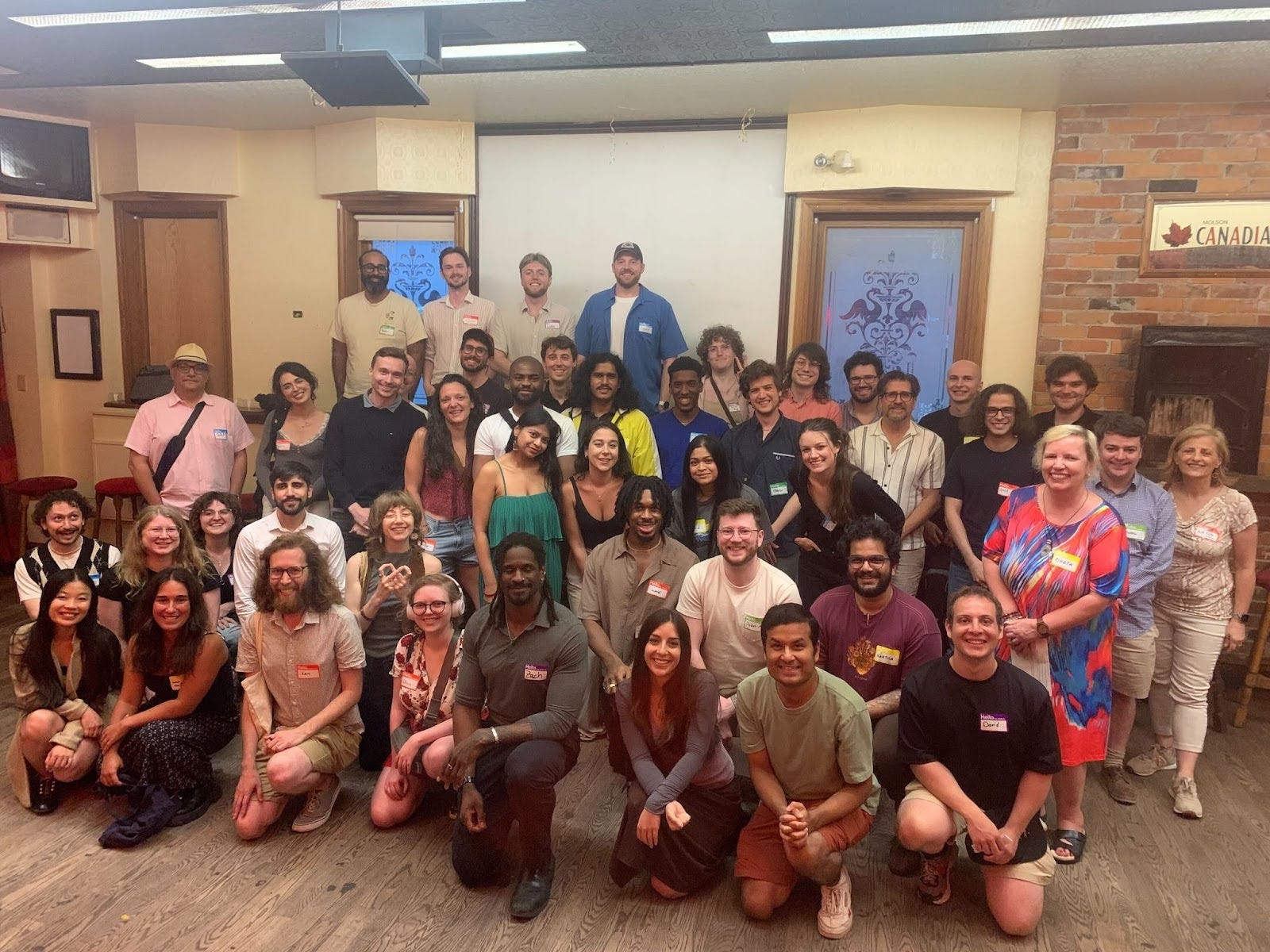
Exercising our intellectual autonomy involves coming to know something by ourselves, as a result of gathering our own evidence and doing our own reasoning, rather than just taking someone else’s word for it. At our Curiosity Café last Tuesday, moderated by Kenneth Boyd and Zachary Grey, we began our discussion with the question: What’s so great about intellectual autonomy anyway?
Consider the following two people:
Maverick Macy: Macy is an extremely independent thinker. She refuses to rely on the vast intellectual resources that are afforded to her by others: instead, she insists on figuring everything out for herself, and refuses to take anyone’s word for anything.
Dependent Darcy: Darcy relies on others to learn about everything: they nearly always defer to someone else in inquiry. They even defer about to whom they should defer. When asked what they think about a particular issue, they immediately turn to others for answers.
Now ask yourselves (as we did):
Is there something wrong with the ways that Macy and Darcy live their intellectual lives? If so, what?
Which of the two extremes of Macy and Darcy is preferable? Consider someone who is halfway between the two. What are they like?
In classic Curiosity Café fashion, you were evenly divided on the question of whether it’s better to live our lives as a Macy or a Darcy. Here’s what some of you had to say:
Though both extremes have their flaws, being a Darcy is clearly the worse of the two.
At least, as a Macy, we practice critical reasoning skills that we can apply in other domains of our lives.
If you were a Macy, you’d have to engage in the kind of process Descartes does in his Meditations: rejecting everything but what you yourself know beyond doubt, and building from there. You wouldn’t be able to know much—but at least you’d be able to know something.
On the other hand, Darcy is happy to take in information from different sources, meaning that they are more likely to encounter different viewpoints and thus come to a broader understanding of the world than Macy.
Neither Macy nor Darcy is a critical thinker. Being a critical thinker means being able to adopt both positions in different contexts, sometimes in parallel.
Being a Macy is better when you want to be a specialist on a subject. The time invested in learning things by yourself would be worth it. Being a Darcy is better when you want to be a generalist on a subject and are not interested in investing the time to verify each claim.
Being a Darcy is the safer choice because you aren’t taking on the risks of going against the stream like Macy.
Furthermore, when it comes to basic needs and functioning, it’s better to be a Darcy. Surely, learning to start a fire from scratch because you don’t trust the flint and spark method is not the mark of an independent thinker. Such skepticism would make it very hard for you to get anything done!
We can only become a Macy after being a Darcy. All of us had to adopt the Darcy outlook first by listening to the people who taught us how to, well, be and survive as people in this world (for instance, our caregivers and our teachers). But that’s not all. Before we become Macy, we also need to:
Invest in a shared foundational understanding of how to legitimately obtain knowledge. For example, perhaps we should follow the scientific method, which is not independently verifiable.
Recognize our limitations and biases when it comes to reason. Otherwise, we risk being overconfident in our ability to reason independently. (Psst, scroll down to the Readings & Resources section, if you haven’t already, and check out the recommendation for Daniel Kahneman’s Thinking, Fast and Slow, a fascinating popular psychology book about our cognitive biases.)
Ultimately, it’s better to be somewhere in between Macy and Darcy. Is there a sweet spot we should all strive to hit?
We shouldn’t try to form a universal rule for whether it’s better to be a Macy or Darcy at all. Instead, where you should land on the Macy-Darcy continuum is context-specific: it depends on the particular kind of knowledge you are seeking, and your relationship to it. For instance, for knowledge that relies in part on one’s own lived experience, it might be better to lean towards being a Macy. For areas in which no one—experientially or otherwise—is an expert, it might be better to lean towards being a Darcy.
In thinking about where we want to be on the Macy-Darcy continuum, we should remember to operate with intellectual humility, while simultaneously recognizing that even experts have biases.
We often think it’s good to figure things out for ourselves. Why might it be good, though? When might it be bad?
Independent thinking is a good practice to cultivate: it is both an instrumental good—something that can promote good outcomes when applied in different life domains and that can lead to a sense of purpose—and a non-instrumental good—something that is good for its own sake.
Figuring things out for ourselves is an important skill to cultivate because there are people, groups, or institutions that might have vested interests in misleading us, and blindly trusting them can lead to harm to ourselves or others.
Most, if not all, innovation happens as a result of an individual or a group of people challenging the status quo. Critical thinkers who question dominant practices are those who push society forward.
At the same time, the world is too complicated to rediscover everything from scratch. We need to rely on pre-existing knowledge and knowledge currently being generated by others to incrementally learn more about the world and how to live well in it.
When the consequences of getting things wrong are high, it’s probably not a good idea to prioritize figuring things out by ourselves. For example, if Macy isn’t an electrician, she probably shouldn’t try to fix an electrical issue in her home. We can also imagine very harmful societal consequences of getting things wrong on a mass scale.
We then considered two independent thinkers and asked whether both thinkers exhibit intellectual autonomy. What do these cases say, if anything, about the value of thinking for yourself?
Galileo Galilei: challenged the geocentric model of the cosmos based on his observations and scientific reasoning and proposed the heliocentric view, which conflicted with the dominant view supported by the Catholic Church at the time.
Mark Sargent: challenged the “globe earther” model of the world and proposed the “flat earth” view, based on his observations and reasoning, which conflicts with the dominant view supported by the contemporary scientific community.
Independent thinking has limits. Even Galileo adhered to the scientific practice of empirical observation and verification (so even he wasn’t a total Macy). Sargent, on the other hand, does not, and so intellectual autonomy has costs, if it goes too far unchecked.
Of course the scientific method does not have a monopoly over legitimate methods of truth-seeking. After all, Sargent uses visual observation and other methods to support his theory, too.
The main difference between the two thinkers is the degree of motivated reasoning. Sargent might be motivated to continue believing in the flat-earth theory because it provides a sense of community and perhaps economic security, whereas Galileo, presumably, was motivated by the search for truth.
Mark Sargent might be wrong about the Earth being flat, but what makes him wrong is not that his view differs from the status quo. In fact, in and of itself, there is something good—refreshing even—about knowledge-seekers and transmitters who adopt views that do not adhere to the status quo.
Being an independent thinker means being willing to engage with other views and change your mind. Good independent thinkers are driven by their pursuit of the truth, rather than the desire to win arguments.
Being an autonomous thinker is not the same as being an independent thinker. If we had an autonomous vehicle that kept ending up in rivers and lakes, we wouldn’t consider it truly autonomous. Being autonomous seems to imply being successful at navigating the world, and this often requires that we rely on others and their knowledge. Being an independent thinker who always gets things wrong does not make you an autonomous thinker.
In the second half, we considered the following cases and asked whether you felt differently deferring to scientists than to moral and political thinkers:
Science: You see a bright flash in the night sky, and you want to know what it is. You turn to your friend Professor Science, who tells you that it’s a meteor that originated from outside our solar system.
Politics: You see that there’s an election coming up and you want to know whom to vote for. You turn to your friend Professor Politics, who tells you that the National Philosophy Party is the best choice.
We also asked the following questions:
Sometimes, we need to rely on others to become more independent. Can you think of examples from your own life (classes, friends, online spaces) where others helped you become a more independent thinker?
What are some features of those communities, spaces, or relationships that aided you?
Are there any cases where this goes wrong? Why and how?
When it comes to fostering a person’s intellectual development, at what point should the focus shift from providing information to encouraging autonomous exploration?
Should intellectual autonomy be the goal of education?
How can we avoid the promotion of arrogance and distrust amongst intellectual communities?
Here are a few of your thoughts:
In matters of science, we should defer to scientists, whereas in matters of politics, we should not defer to political “experts.”
The physical world is more predictable than the political one, as we have learned through millennia of observation and experimentation. Therefore scientists, being learned in their disciplines, typically relay the kind of information supported by empirical observation and research.
Political scientists are not very good at predicting what will happen politically, whereas scientists are much better at predicting what will happen in matters of science. So, we should trust Professor Science but not Professor Politics.
There is broader consensus amongst scientists than there is amongst people who are considered experts in politics. This makes the scientific community easier to trust.
Politics is more about values and morals, while science is more about objective facts that we have access to. Therefore, I’m less likely to defer to others about what values and morals my government should represent than I am to defer to those who have access to objective scientific facts, such as the fact that there is a meteor in the night sky.
Whether or not I defer to others in science or politics depends on my competency. For example, I’m much more competent in the moral dimensions of politics than in mathematics and physics, and therefore, much more likely to defer to others when it comes to the latter subjects.
The way this is framed, Professor Politics is your friend. Given that he is your friend, it makes sense to trust him when he tells you whom to vote for. Why? Well:
You probably wouldn’t be friends with him if he didn’t share your values, so you can trust that as long as his empirical research is accurate, he’ll recommend a party that is aligned with your values.
He knows you and has your best interests in mind, so you can trust that he will tell you the best party to vote for (maybe even regardless of his values).
Here are some of the individuals, spaces, relationships, or communities who have pushed some of you to be more independent thinkers:
Teachers. The best teachers are those who do not impose their own perspectives on their students, which encourages students to form their own opinions.
Individuals who help us understand our biases and become aware of our limitations as independent thinkers.
Individuals who, through our relationships with them, have helped us to become more aware of ourselves. Self-awareness can help highlight the biases and triggers that we need to unlearn in order to get closer to the truth.
Communities like Being and Becoming, and events like the Curiosity Cafés, help us to become more intellectually autonomous through encouraging people to deliberate together collaboratively (no, this point wasn’t from someone on our team 😉)
That’s all from us. If you want to continue cultivating your ✨intellectual autonomy ✨, join us at our final Philosophical Skills Workshop, and our next Curiosity Café😉 Thanks for reading.
Community Survey
For those who’ve attended our Curiosity Cafés, please consider taking our brief community survey. We are conducting this survey to gather feedback on our events, and it should only take a few minutes to complete. Your responses are completely anonymous and will be invaluable in helping us improve our offerings. Thank you in advance!
What’s so great about intellectual autonomy?
By Kenneth Boyd
There seems to be something valuable about thinking for yourself. History is full of people we have idolized for their ability to think in ways that no one else could, who stood up against the status quo and defended what they thought was right: Galileo, who challenged the church and defeated geocentrism; Newton, who was able to construct an entire theory of physics using only his mighty brain; Darwin, who meticulously gathered evidence all on his own to create the theory of evolution; and so on. As their respective stories go, these great thinkers liberally exercised their intellectual autonomy: their capacity to figure things out themselves, gather their own evidence and draw their own conclusions.
There are lots of reasons why we value intellectual autonomy in our everyday lives, as well. Figuring things out ourselves can help us develop a deeper understanding of an issue, and there might be some things that necessitate that we gather our own evidence and experience to know them at all.
But it is common to see people confuse exercising intellectual autonomy with exercising it virtuously. Take one of the common aspects of the Great White Men of Science stories above: the rejection of orthodoxy. It certainly takes intellectual autonomy to reject what other people commonly take to be the truth. But rejecting orthodoxy is not on its own a sign of a virtuous pursuit of the truth—conspiracy theorists, for example, famously reject orthodox views. Similarly, we often see those who proclaim that we should “do our own research” or say that they are “just asking questions” portraying themselves as “free thinkers” and thereby intellectually autonomous in a way that separates themselves from the credulous masses. However, in many of these cases, we don’t see people advancing science or discovering new ways of thinking; rather, we see them rejecting established knowledge, ignoring experts, and interpreting evidence in selective ways.
In the last café, we asked what differentiates a virtuous exercise of intellectual autonomy from simply not believing what others tell you. Something that became clear was that autonomy shouldn’t be conflated with mere independence: in our pursuit of truth we are reliant on one another, and we are only able to gather evidence and draw conclusions because of the work of those who figured things out before we did. It is thus not only undesirable but likely impossible to truly go it alone in our intellectual pursuits.
Once we recognize just how reliant we are on others to learn things, though, we might ask: why all the fuss about intellectual autonomy? For instance, philosopher Neil Levy has argued that we should think of the intellectually virtuous person not primarily in terms of their capacity to think in isolation from others but to think with them, instead. That doesn’t mean that it’s never worthwhile to challenge orthodox views. But it does mean that when we think about the best ways to learn important truths our first instinct shouldn’t be to attempt to pursue them alone.
Upcoming Events
Curiosity in Session is Being and Becoming’s new educational initiative. It seeks to facilitate public access to philosophy while increasing public philosophical literacy through alternating bi-weekly (on alternate weeks to cafés) Curiosity Classes and Philosophical Skills Workshops.
Save the date for our last Philosophical Skills Workshop of the Summer: Thought Experiments and Counterexamples on Saturday, July 19th, from 1:00 to 3:00 p.m. at the Parkdale Branch of the Toronto Public Library (Parkdale Auditorium, 1303 Queen St. West, Toronto, ON, M6K 1L6).
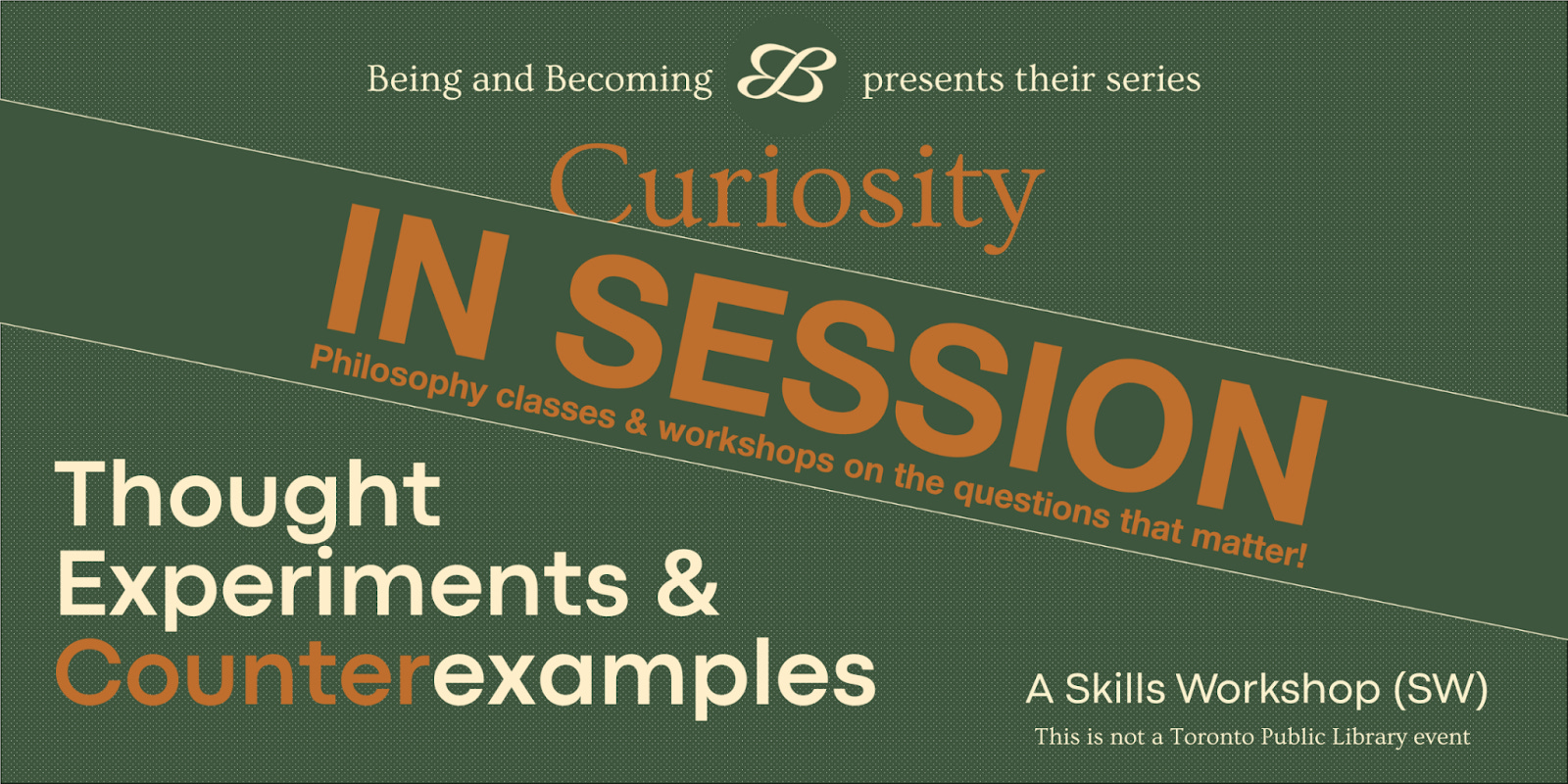
Wondering what in the world “thought experiments” and “counterexamples” are?
Suppose that, one day, you encounter a child drowning in a pond. Or, here's another scenario: a runaway trolley is racing down a track toward you. Finally, imagine a world in which red and green are inverted on the colour spectrum: what would you do?
What all of these supposings and scenarios have in common is that they are each the set-up for (famous!) imaginary cases that philosophers call "thought experiments." The purpose of a thought experiment is to create a well-defined situation or example, free from variables, that tests our philosophical intuitions. Thought experiments are immensely popular among philosophers; so much so that some thought experiments have even become infamous—like the ones above by Peter Singer, Phillipa Foot, and John Locke, respectively.
But how do you craft a well-formed thought experiment? And how do you argue against one, if you think that it delivers the wrong result?
The answer to this second question is through what philosophers call “counterexamples” (or counter examples, or counter-examples—philosophers aren't picky). And the answer to the first question is: by coming to our final Philosophical Skills Workshop of the summer!
Together we will:
Investigate (in)famous thought experiments, such as Singer's “drowning child,” Foot's “trolley problem,” and Locke's “inverted spectrum”
Practice crafting original, well-formed thought experiments of our own
Gain hands-on experience identifying counterexamples that undermine the conclusions of arguments that rely on thought experiments
Use code Philosophy50 for 50% off!
Curiosity Café: Bi-weekly on Tuesdays, tickets* below!
*Psst: hey community! Sophia here, Director of Community Programming. Right now, we are working towards the goal of providing those who contribute to making the cafés happen equitable financial compensation for the work they do, so that we can feasibly and sustainably develop as an organization and provide more programming for all of you. We also want to keep our cafés as accessible as possible, so we are keeping the pay-what-you-can model in place for tickets. We ask that you consider that our ideal recommended amount for a ticket is now $15, and as you choose what to donate within the bounds of your own financial means, we ask that you keep in mind that your donation will go directly towards compensating those involved in making Curiosity Cafés happen so that we can keep doing this for you.
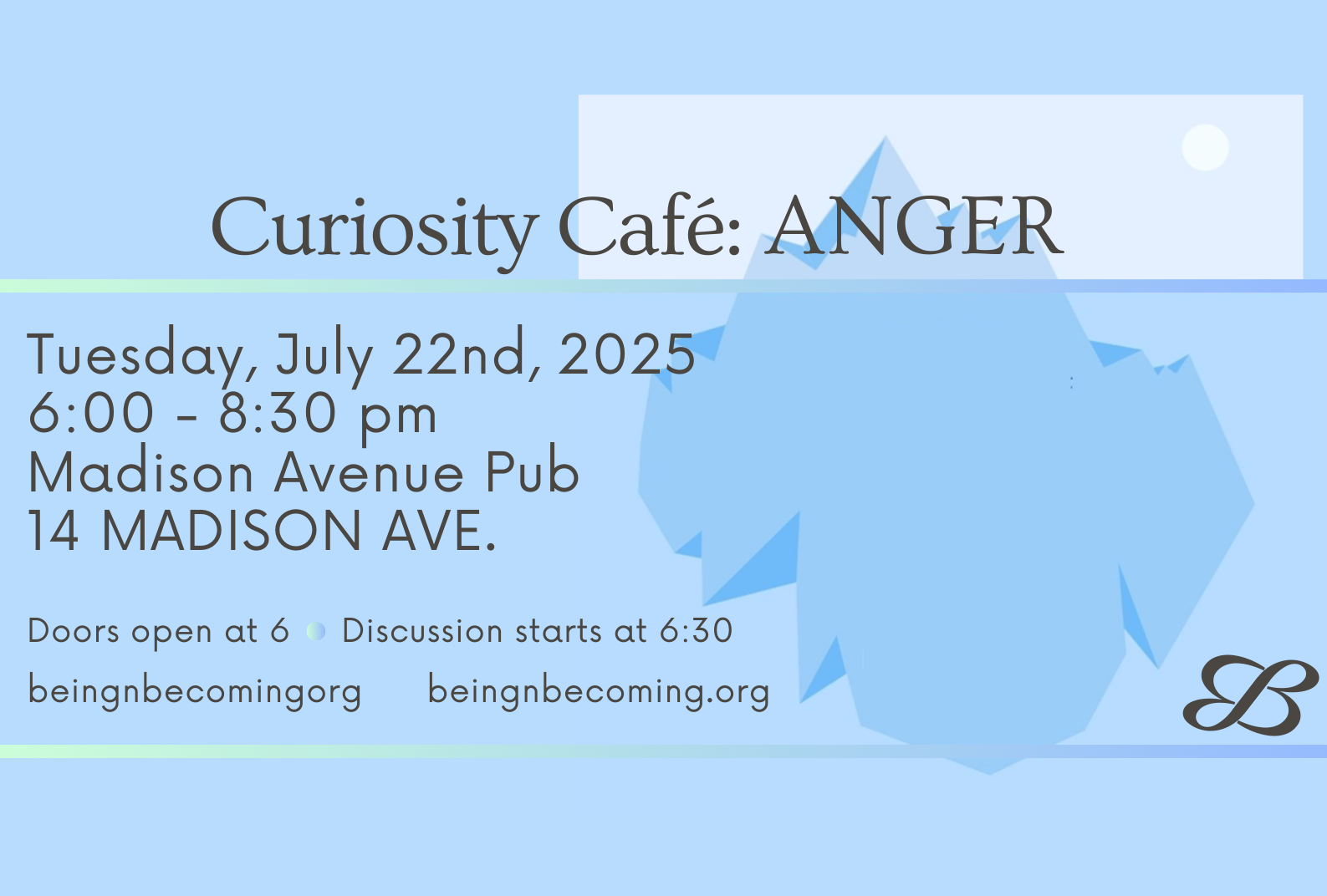
We will host our next Curiosity Café on Tuesday, July 22nd, from 6:00 to 8:30 p.m. at the Madison Avenue Pub (14 Madison Ave, Toronto, ON M5R 2S1). Come and hang out with us, grab food, and read through our handout from 6:00 to 6:30 p.m. Our structured discussion will run from 6:30 to 8:30 p.m. with a 10-minute break in the middle!
The topic of our next café is: Anger
Missing the event description? Head over to our Eventbrite page! We’re trying to make the length of our newsletters a little less overwhelming.
If you have accessibility-related concerns, please visit our Eventbrite page—in the event description, you will find some accessibility-related information about the venue and the event.
We still have five free tickets available for our attendees. If paying anything at all is not financially feasible for you or our ticketing system presents some other barrier, please contact our Director of Community Programming, Sophia, at sophia@beingnbecoming.org. These tickets will be given away on a first-come, first-served basis, no questions asked! You can expect to hear back from her within 72 hours.
Readings & Resources
Sofia’s Recommendation:
Thinking, Fast and Slow by Daniel Kahneman. This book is a fascinating and engaging compilation of our cognitive biases and the limitations of our intuition. For example, did you know that we rely too heavily on the first piece of information we receive when making decisions, even when it’s not relevant? Or that we create coherent narratives about the past even when the events were random or complex? To this day, it’s one of the most influential modern popular psychology books ever written and is always one of my first recommendations for anyone interested in psychology.
Featured Quote
To go wrong in one’s own way is better than to go right in someone else’s.
- Fyodor Dostoevsky
Our mission is to present a diversity of perspectives and views. The views and opinions expressed in this newsletter are solely those of the individual authors and do not necessarily reflect the views or opinions of Being and Becoming. Being and Becoming disclaims any responsibility for the content and opinions presented in the newsletter, as they are the exclusive responsibility of the respective authors. If you disagree with any of those presented herein, and you feel so inclined, we recommend reaching out to the original author and asking them how they came to hold that opinion. It’s a great conversation starter.